 FLIGHT IN TRANSIT
Ford’s clever E-Transit is very fast and very frugal. Jonathan Crouch takes a look.
Ten Second Review
Ford has re-imagined what a large full-battery van should be and
come up with this, the E-Transit, which sets a fresh segment
benchmark. If your business has been waiting for a large fullelectric LCV that really adds up, that day may have arrived.
Background
To be absolutely honest, the properly large-sized full-electric vans
we’ve had to date haven’t been very good. The driving range and payloads have been disappointing and the prices high. Time for something better: time for this, the Ford E-Transit.
The Blue Oval brand is the last of the major LCV market players to bring a large EV to market, but it’s been worth waiting
for. There’s a motor from the Mustang Mach-E, a class-leading driving range, proper car-like coil-sprung suspension and a
price which undercuts some rivals by up to £10,000 or more. Interested yet?
Driving Experience
A lot’s gone on here. There’s a choice of two motors, both derived from the one used in the Mustang Mach-E. The lowerpowered unit offers 184PS: the higher one 269PS, massively more than any other van on sale. Also borrowed from the Mach-E is the 68kWh battery pack, which offers a combined and class-leading range of 197 miles. The brand decided to put the drive motor at the back, which meant the need to completely redevelop the rear suspension. Out went the combustion model’s leaf springs and live axle and in its place were added far more car-like coil springs and independent
suspension.
There’s the usual single-speed EV auto transmission, which has a selectable ‘L’ setting for greater brake regeneration. There are also three driving modes – ‘Normal’, ‘Eco’ and ‘Slippery’. And there’s even an ‘on-board driving coach’, which takes the form of a percentage display on the centre screen but can also talk to you if it thinks you need instruction. It might conceivably tell you off for enjoying the instant acceleration too much (there’s a potent 430Nm of torque). That’s something you’ll struggle not to do in that high powered version. Just as well then, that handling, always a Transit strong point, has been improved by the way that the battery pack beneath the load floor lowers the unloaded centre of gravity by about a foot. That’ll help traction out of corners and roundabouts.
Design and Build
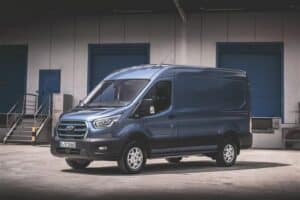
From the outside, there aren’t too many giveaways as to this E-Transit’s full-battery status. Not unless you see one plugged-in of course – the CCS socket is in the nose section, which sees the grille featuring chrome blue trim accents. The space behind that grille isn’t empty: Ford has stashed there all the vehicle control systems and incorporated into this area a crash structure that it calls the ‘Mega Brace’. This aims to replicate the structural role of a conventional engine in a frontend accident.
At the wheel, there’s a big 12-inch centre infotainment screen running Ford’s latest ‘SYNC 4’ media system. Operators will be interested in the ‘ProPower Onboard’ set-up that can use the main drive battery as a source of power for tools and equipment. For that, there’s a conventional plug socket in the cab, with two more in the load area and these can draw up to 2.3kW of power.
Otherwise, it’s just as in a diesel version. The multi-adjustable steering wheel allows a decent driving position and the gear lever is located close at hand. There’s a console that’s loaded with buttons to control the various stereo and phone controls, helping you to take calls safely on the move. In fact, the biggest compliment you can pay is that it feels resolutely car-like.
Even if you don’t want to acquire a Ford E-Transit, you can hardly doubt this vehicle’s significance. Imagine how much stuff is delivered to your work or your home in a big Transit each year. And imagine what the environmental impact will be of an increasing number of such vehicles being of the full-battery kind. This isn’t just a significant step for Ford; it’s a significant step for our transport system.
Rather than simply throwing an EV powertrain at an existing combustion model to get a product quickly to market (as most of its competitors have done), Ford has taken its time and done the job properly. This 2-tonne Transit design might be familiar, but in some ways, this Electric version offers a deeper dynamic redesign than is the case with the separate midsized E-Transit Custom model, which Ford developed with Volkswagen. Future Ford vans will all be rebadged Volkswagens, but this one isn’t. And maybe, just maybe, it’s better that way.
Want More Information on the Ford E-Transit or the other Electric Vehicles available from Crusader Vans? Contact us